

How We Price: Cost-Plus, Explained
Ask most builders what your project will cost and you'll get a vague answer. Ask how they price and you'll get a vaguer one. We'd rather put it in writing.
New Urban Homes builds on a cost-plus contract: you pay what the work actually costs. This means labor, materials, and subcontractors plus a builder fee we agree on before anything is signed. Every discount and preferred rate we've earned from our vendors over eight years is passed through to you at our cost. The number on the receipt is the number on your budget.
What cost-plus means (and why we build this way)
In a cost-plus contract, the client pays the actual, documented cost of construction plus an agreed builder fee percentage of construction costs, not allowances. The builder's compensation is transparent, so there's no incentive to swap in cheaper building materials to protect a margin. In a fixed-price contract, the builder keeps whatever they don't spend, so every dollar saved behind your drywall is a dollar in their pocket.
That incentive problem is the whole story. A fixed price sounds safer, and for some projects it's a fine tool and we'll tell you honestly if yours is one of them. But on a custom home or major renovation, hundreds of decisions get made after signing. Cost-plus means that when we choose between the right waterproofing detail and the cheap one, we have no reason to choose wrong. You get full choice on every product in your home and complete visibility into what each choice costs.
What it actually costs to build in Northern Virginia
Here's the number most builders won't publish: a New Urban Homes custom home generally starts at $250 to $275 per square foot, soup to nuts: soft costs, permits, and construction.
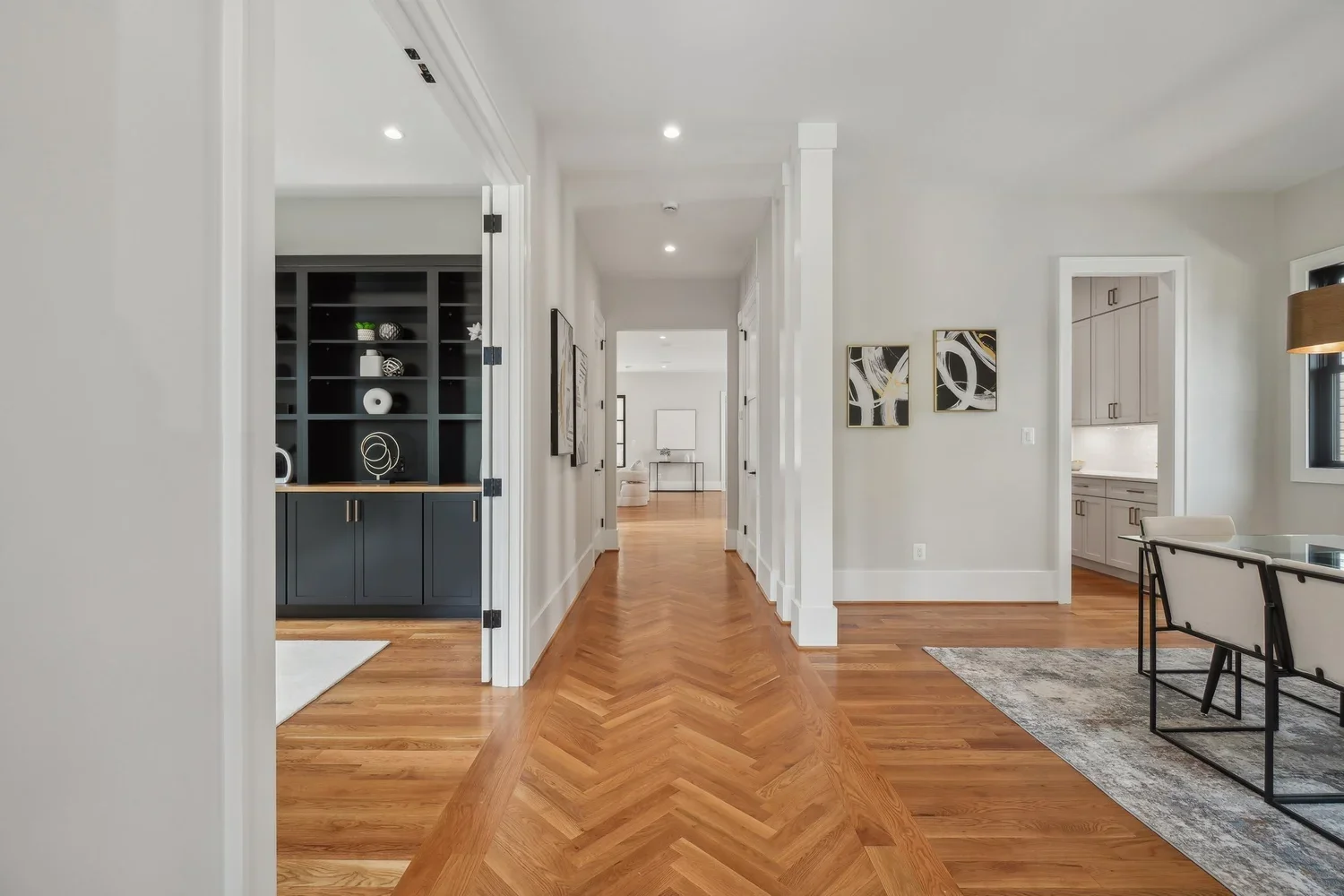
That's not a stripped-down base price. It includes demolition of the existing house, full stormwater system installation, landscaping and hardscaping, premium windows, 8-foot doors on the main level, stained-grade front door, hardwood floors in every bedroom (no carpet), designer fixtures and tile, chef-level appliances, and all wood cabinetry. The infrastructure, foundation, framing, and waterproofing all done right because that's not negotiable here.
What moves the number: your jurisdiction's permit and stormwater requirements (Arlington and Fairfax differ for example), your lot, and your finish selections. We'll give you a real range for your project in the first conversation.
And a piece of honest advice: if someone quotes you $225 per square foot, ask what's not in the number. Usually it's the stormwater system, the site work, the soft costs or the quality of what goes in the walls.
Where the money goes
From a real budget for a 5,000-square-foot home we estimated this year with rounded percentages of construction cost:
| Category | Share of construction cost |
|---|---|
| Allowances & interior finishes | ~25% |
| Carpentry | ~17% |
| Mechanical, electrical & plumbing | ~11% |
| Site work & demolition | ~9% |
| Building envelope — roofing, siding, waterproofing | ~9% |
| Foundation & concrete | ~8% |
| Windows & doors | ~7% |
| Soft costs, permits & insurance | ~7% |
| Supervision, site requirements & stormwater | ~5% |
| Miscellaneous | ~2% |
Notice that roughly a quarter of the budget including building envelope, foundation, and site work is spent where you'll never see it. That's exactly where we refuse to cut corners, and exactly where a fixed-price builder is most tempted to.
How open-book works during your build
At contract signing, we set a draw schedule so you know when payments happen for the entire project. At every draw, you see real costs to date. Builder discounts and preferred vendor pricing are passed through directly to you: no allowance markups, no hidden margins, nothing to hide on our end.
And when a project comes in under budget, the difference is yours. That's happened, and we honor it every time so that the fee we earn is less than the fee in the contract.
Common Questions
Is cost-plus riskier for the homeowner than a fixed price? It shifts the question from "what did I agree to pay?" to "what does this actually cost?" and gives you real control over the answer. We manage that risk the way it should be managed: a detailed itemized estimate before you sign, backed by years of our own cost data, and real costs reported at every draw so there's never a surprise at the end.
What's your fee? A builder fee percentage agreed on before we sign, stated plainly in the contract. It doesn't change when you upgrade a finish allowance, and it's the only way we make money on your project.
Do you mark up allowances or materials? No. Vendor pricing, including our builder discounts, passes through to you at our cost. On many products our clients pay less through us than they would at retail.
What happens if the project goes over budget? We tell you early, show you the real numbers, and lay out the options because we're watching costs at every draw, not reconciling at the end. And if we come in under then the savings are yours not ours.
How much does it cost to build a custom home in Northern Virginia? Plan on your custom home starting at $250 to $275 per square foot all-in for soft costs, permits, and construction for a custom home at the quality level we build. Jurisdiction, lot conditions, and finish quality drive the variation.
Get a real number for your project.
Bring us your plans or just your idea and we'll tell you what it actually costs to build it right. Honest numbers from the first conversation.